Showing posts with label cacti care. Show all posts

Monday, March 14, 2011

When is the time to repot the cactus???

Normally, we should repot the cactus at least once a year but if you want the cactus to grow faster, you may change its pot every 5-7 months upon the size and age of the plant.

However, somebody who is very lazy (like me) may repot when it’s really necessary.  When is it???  You can notice the good time to change the cactus pot when
Hard top soil

  •  Cactus size is too big for the pot 
  • Cactus is growing slowly
  •  The top soil is so hard 
  • Root on top soil
  • Cactus root’s is on the surface of the pot because there is no more food/fertilizers at bottom of pot.  (Sometimes, it’s true but I have an experience: one of my cacti grown on the surface.  At that time, I changed its pot and its root was still on the surface again.  I re-potted again and its root was still on the top of the pot.  I asked my cactus advisor and she said that’s the habit of that cactus.)

my Pachypodium
However, you should know about the dormant period of each cactus & succulent.  For example, my Pachypodium always leave its leaves and stop growing since October. It will have new leaves and grow up again at the beginning of rain season (about May).  So I repot it before May.  Dormant plants are weak and can't really defend themselves against infection.  Meanwhile, any damage done to the roots during repotting will be dangerous to the plants.

Right Season to do it

Normally, I’d recommend before or at the beginning of the rain season because it’s not too dry or too wet.  And the new pot can support the plant growth in the rainy but you should be careful about the infection and being rotten if you repot during the rain season.  So please change the pot before the rain comes.

However, that’s the general suggestion.  You should understand your plants well.  There are some species that can tolerate every thing you’ve done with them, but others could not truly tolerate any stress.  So please pay attention and time to observe your cactus.

Monday, December 17, 2007

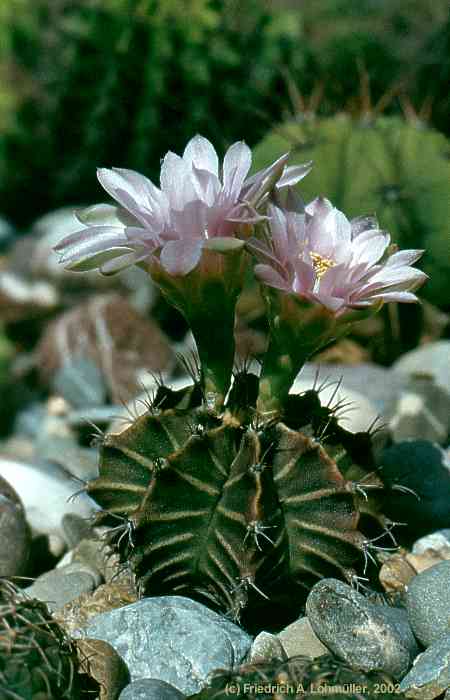
Gymnocalycium Cacti

Gymnocalycium cacti are native to the Brazil, Paraguay, Bolivia and a few other South American countries where they grow in quite arid areas. These cactus have cylindrical stems which rarely get taller than around 8 inches with a diameter of 5 inches. All of the Gymnocalycium cactus have fairly large and showy flowers which are are white, yellow, orange and pink. The flowers are borne at the growing point of the cactus on short stems.

Temperature

From September though May you will need to keep these desert cactus in a warm and sunny position avoiding only strong direct sunlight. From May onwards they benefit from being kept out of doors in a sheltered position where they will get full sun, some species will require light shade.

Pot Type

Gymnocalycium cactus are best grown in a terracotta type pot which should have at least one drainage hole in the base and it should be unglazed. This type of pot allows good drainage and allows the compost (therefor roots) to breath.

Watering

These plants should be kept moist at all times during the growing season which is April/May through September, water these plants every few days or every day in hot weather.

Lighting

Grow Gymnocalycium cacti in full sun during the summer and winter, if kept too dark they may become overly lush and could be prone to rotting due to over watering, they will also be shy to produce flowers. Some of the species such as G. calochlorum, G. mihanovichii & G. oenanthemum will need some form of shading during the hottest hours of the summer.

Feeding

If the compost is fresh then feeding may not be necessary at all, if the plant hasn't been repotted recently then half strength general purpose fertilizer can be used at watering time from May onwards once a month. Do not feed the plants from September onwards as this can cause lush growth which can be fatal during the darker cold months.

Repotting

Repotting should be done every other year or every three years, annual potting is not necessary. Remove the plant from its put by wrapping newspaper around the stem if it is very spiny. Carefully tap it out of the pot and remove the old compost to examine the roots, if any are damaged or showing signs of rotting they should be removed as close to the plant as possible.Re plant the cactus using the same mix of compost as it was originally in (fresh) and use a pot just slightly wider then the width of the cactus. Do not be tempted to over pot as this will cause the unused compost to go stagnant and you may loose the plant.

From www.easycactus.co.uk