Showing posts with label fungus. Show all posts

Wednesday, May 16, 2012

Cochineal vs Cactus


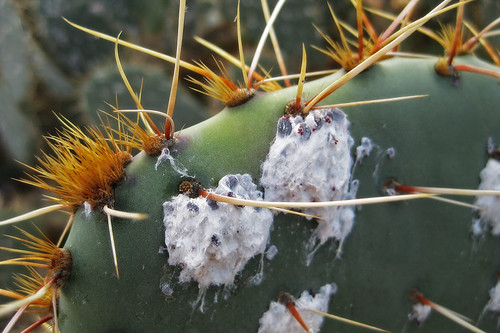
When you look at the white spot covering on Opuntia, do you think it's from fungus or insect?  The answer is from an insect infestation. The white sticky mounds are the housing for cochineal bugs (also known as mealy bugs.  


 The white sticky mounds are the housing for cochineal bugs (also known as mealy bugs)  All of the host plants of cochineal colonies were Opuntia species. Cochineal feed on plant moisture and nutrients.


Like the aphid (a related insect) the female drives her tubular proboscis through the cactus skin, where she will remain affixed for the rest of her life, sucking out the juice.  Simultaneously, she produces a white, waxy, fungus-looking coating that will help protect her from predatory insects and birds and shade her from the desert sun.  However, she sometimes fall prey to a rare carnivorous caterpillar and more commonly, to our good friend, the ladybird beetle.  Over time, a heavy cochineal infestation can kill its resident plant. 


However, Cochineal has industrially important insects because Cochineal can produce scarlet, orange, and other red tints. The  colors are produced from carminic acid which is today primarily used as a natural dyeing for food, pharmaceutical and cosmetics industries .  And seriously, there are cochineal farms for export in some countries such as Peru, Australia, Mexico, Chile.

If you don't want cochineal on your healthy plants, it’s suggested to treat  the damaged areas by scrubbing them with insecticidal soap or unscented dish soap. In small areas you can scrub with a tooth brush but for larger areas it is best to use a long handled brush. Or you can just spray all of the surfaces of the prickly pear pads thoroughly using a power nozzle attached to your hose and then thoroughly spray with a solution of spectraside and insecticidal soap. Do not rinse after applying the spectraside and insecticidal soap.


source: http://www.desertusa.com, http://www.thecactusdoctor.com, http://en.wikipedia.org

Thursday, March 31, 2011

Cactus vs Fungus

Here are the fungus found normally in cactus.

1. Cactus Anthracnose (fungus – Colletotrichum (Gleosproium) spp): This disease affects several kinds of cacti, cereus, echinocactus, mammillaria, and particularly, opuntia (prickly pear). Infection results in a rather moist light brown rot that shows many light pink pustules on the surface. Spots are small at first, later enlarge, and become covered by the small spore-producing pustules. 
Large areas may be affected, sometimes destroying entire plants. No satisfactory control is available, other than removing and destroying diseased cladodes as soon as noticed. In the greenhouse, soil from infected plants should be removed and benches disinfected. Spraying with a copper fungicide may help in checking this disease.

2. Scorch or Sunscald (fungus – Henersonia opuntiae): This disease is common and
serious on prickly pear cactus (opuntia). Spots at first are distinctly zoned, later enlarging until entire cladodes turn a reddish-brown and finally die. The center of the disease area is grayish-brown and cracked. Other fungi may be present in the diseased area. No practical control has been developed.

3. Cotton Root Rot (fungus – Phymatotrichum omnivorum): Several members of the
cactus family are susceptible to attack by the cotton root rot fungus. Infected plants die.  When pulled from the soil the brown strands of the fungus can be found growing on the root surface. No control practice is available.

4. Scab (physiological): Particularly common on prickly pear cactus. Rusty colored, corky areas appear on the stems. Scab is thought to be a form of edema, resulting from over watering and poor ventilation. Increase light and decrease humidity for control.

What to do when cactus are infected?

  •        Quarantine and remove infected plant material.  
  •        Repot and cut off the infected area if it’s not severe and it’s possible to cut.  Cut behind the infection so that you can throw the fungus away entirely.  If it’s severe, destroy affected plants and their pots.
  •         Set the environment of your greenhouse or garden to be more appropriate for the cactus.  The causes of fungus are sometimes poor ventilation, light or humidity.
  •          Dust the both infected and healthy plant with Bordeaux mixture or another fungicide.  
Preventing the fungus 

1. Back the basic, pay attention and take care of your plants closely.  Mostly, the infection can invade your garden when you don’t have time to check or care the cactus.  (This case ever happened with me, too)

2. Get rid of the fungus/infection as soon as you find it.  The earlier to figure the fungus, the easier to control it.


3. Giving more time to spray the fungicide (every one or two weeks), repot and fertilize the plants.

Every plant is same; cactus, succulent, orchid, rose or else.  If you take care of it well, it will grow up greatly and make you proud


If you have any comment or question, please feel free to contact me :)