Site dedicated to the cactus and succulent. You can find care tips, fact and information about cactus & succulent and more other gardening & planting
Monday, December 1, 2008
Smiling Moon
It happened when Venus and Jupiter stayed near each another under the moon. They were like this for several hours.
Many people think it's a good sign from the moon (as there is the political conflict in Thiland now) In their thought, the moon and the stars gave the support to them.
For me, it looked beautiful and happened rarely.
Wednesday, November 5, 2008
Care for Cactus in Winter
1. To survive winters, cacti need loose soil and excellent drainage. Unlike other Garden plants, the challenge in growing cacti is the elimination of excess moisture. Sun exposure and drainage requirements can be met by placing cacti on a sunny hill or raised bed, and using ample gravel or sand mixed with a small amount of organic matter. A thin mulch of stone chips or gravel reduces the risk of crown rot.
2. Cacti naturally reduce their moisture content and shrivel with the onset of winter. This dehydration prevents cactus cells from bursting when they freeze. Excess moisture during autumn months can cause cacti to hold too much water and suffer freeze damage. Don't mulch cacti for winter protection, as you do with other plants.
3. Most cacti change color in the winter. This natural occurrence doesn't mean plants are sick. As plants become less active and the amount of green chlorophyll decreases, red, orange, and other color pigments show through the pads or stems.
4. Please check that your cactus are winter-hardy type. If they are not and you don't have a greenhouse or can't move them into your house, you should purchase a large amount of frost cloth from your local nursery to cover all frost sensitive cacti and succulents. If you are not sure what to cover, it is best to be safe by covering all of your succulents and thin skinned cacti such as cerus monstrauss, cerus puruvians, etc. Listen to the weather forecast at night and cover your cacti anytime temperatures will be under 40? F
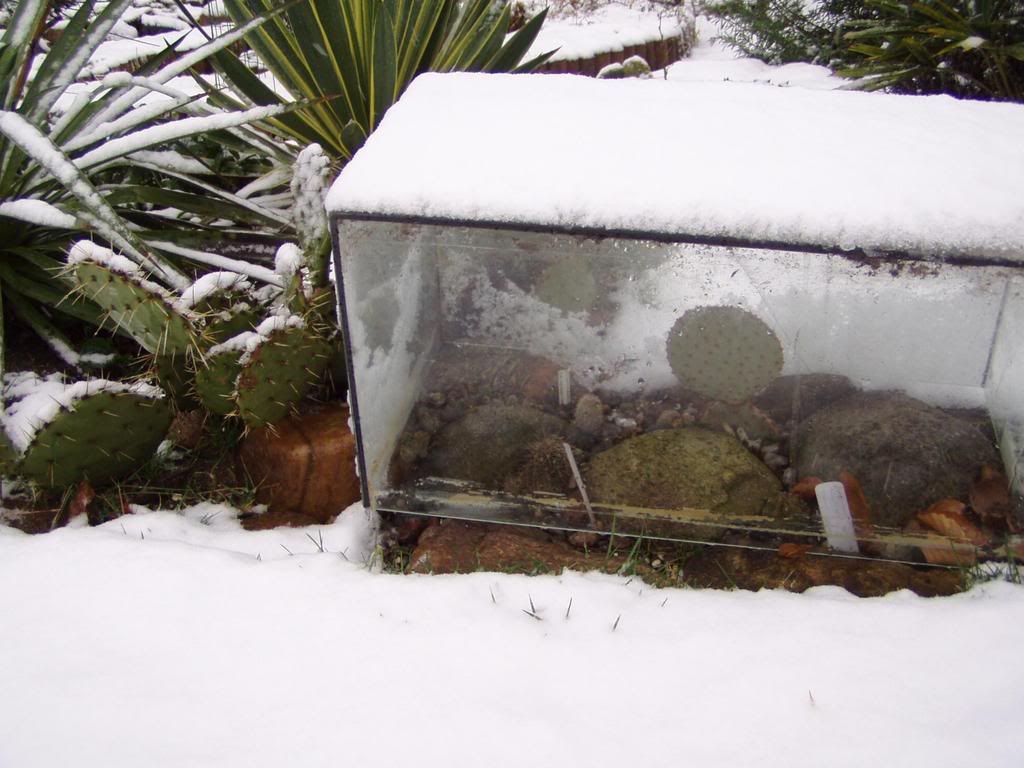
Though it is true that most desert cacti aren’t winter hardy, a number of different species will survive in cooler areas. They include species of ball cactus, barrel cactus, prickly pear, and other kinds of Opuntias.
5. In winter, water plants very infrequently - about once every 3 to 5 weeks. It's the cacti nature to rest and stop growing in winter: dormancy So it doesn't need water much, otherwise, it'll be rot.
6. Although the cacti will have dormancy in the winter, it need still the proper light. Cacti should be kept cool and dry to stop them turning a funny shape.
You don't have to worry about exactly when they stop growing, just make sure the pots have dried out before it gets too cold and dark for them to ever dry out. You absolutely don't want a plant to be sitting in wet soil for 4 months because it doesn't need the water and the pot won't dry out by evaporation.
In spring, watch out for plants which have lost their roots, they may be loose in the pots and will have to be given time just like a cutting. Many more will have lost all their fine feeder roots, which is a natural reaction to drought, and they should be watered cautiously once or twice before completely drenching the pot.
You can find more information from www.cactiguide.com It's the good source about cactus & succulent.
Thursday, September 11, 2008
Ariocarpus fissuratus
Ariocarpus fissuratus is a species of extremely slow growing cacti aound in rare numbers in Mexico and the southern. Commonly called "living rocks," these cacti usually blend in well with the terrain around them. They are greyish-green in color, sometimes taking on a yellowish tint with age.
These cac
ti consist of many small tubercles growing from a large tap root. They are usually solitary, rarely giving rise to side shoots from old areoles. These cacti are difficult to spot in their natural
habitat. When they are found, it is usually due to their pinkish flowers
In cultivation, Ariocarpus fissuratus is often grafted to a faster growing columnar cactus to speed growth, as they would generally take at least a decade to reach maturity on their own. They require very little water and fertilizer, a good amount of light, and a loose sandy soil with good drainage.
Growth Habits: Solitary, grows extremely slowly to 8 inches in diameter (20 cm)
Watering Needs: Little to no water in winter, little in summer, needs good drainage
many years the large mature specimens were collected in the wild, practice that has been severely limited by the new regulations, either in Mexico or in international trade. They are not adapted as house plants as they need a lot of sun and careful watering. The large taproot needs enough room to grow, which complicates the good
drainage requirement, since the deeper the pot, the slower it drains.
The center growing part is sensitive to mealybugs attacks. Since this part is woolly, mealy bugs can be difficult to notice. The plant should be treated as
soon as mealybugs are noticed.
Blooming Habits:
The Ariocarpus fissuratus has large, diurnal, 1.5 inches in diameter (4 cm), pale to deep pink satin flowers in mid summer, followed by fruit buried in the wool.
Source:Wikepedia, http://www.desert-tropicals.com
Sunday, July 13, 2008
The most common Rose Diseases
Rose is the queen of flowers. It is gorgeous and wonderful but is one of weakest plants, too. Rose is always damaged by diseases and pests. And if you have rose in your garden, here is the information you should know.
Common rose diseases vary by area, as the fungi which cause many of them are affected by temperature and moisture. Some of the most common rose diseases are Black Spot Disease, Powdery Mildew, Rust, and Rose Mosaic.
While rose diseases do not always kill rose plants, they often affect the leaves and make it more difficult for the rose to survive in the winter. Step-by-step sowing instructions:
This disease, as its name implies, appears as black spots on the upper surfaces of the rose’s leaves. It is caused by a fungus, which is allowed to propagate in moisture, which can come from rain or watering over the leaves instead of down at the soil. It can also be caught from other diseased plants, as the fungus can spread through fallen leaves, or even through composting of diseased leaves and stems. It causes most diseased leaves to drop off early, but survives through the winter on any leaves that manage to stay on the rose. It can also survive through the winter on the stem.
Rust
This disease is not harmful at low levels, merely causing small orange growths on the underside of leaves. At higher levels, leaves begin to be damaged, which can damage the plant since the leaves are the part of the plant that produces energy.
This disease is different from other common rose diseases, as Powdery Mildew does not need water. This growth, which resembles a white powder, occurs on the top and bottoms of leaves and on stems. In the summer, if roses are free of any fungi caused disease, Powdery Mildew can simply be hosed off of affected roses and thus, can be easy to take care of.
This viral disease does not kill plants. Many rose gardeners do not need to deal with this disease, as all it does it cause splotches, often yellow and green, to appear on leaves.
There are many other rose diseases, and which ones are the most common in each area changes depending on the weather in that area. Ask for free gardening advice from neighbors, friends, and fellow rose growers, or pick up one of the many books available on growing roses.
Once a plant is diseased, there are many gardening tips available as to how to deal with these. An easy gardening tip is simply to prune away the affected areas.
These common rose diseases should not be too much of a gardening problem for any rose gardener, as, with early detection, they can easily be destroyed without the death of the entire rose bush and garden.
Sunday, April 13, 2008
10 Most Easy-to-Grow Vegetables
2. Cucumber. Wait until warm weather to plant seeds. Varieties: ‘Sweet Success,’ ‘Fanfare,’ ‘Lemon’.
3. Green Beans. Plant seeds after frost danger. Bush types are easier to manage, but pole types are more productive in an equal space (because they’re taller). Varieties: ‘Blue Lake,’ ‘Contender,’, ‘Kentucky Wonder’.
4. Lettuce. Plant seeds as soon as soil can be worked -- hot weather ruins the plants. Varieties: ‘Black Seeded Simpson,’ ‘Buttercrunch,’ ‘Deer Tongue,’ ‘Nevada’.
5 Onion. Timing the planting of seeds or the miniature onion bulbs called sets can be tricky. Also consider mail-order onion seedlings. Check locally for availability.
6. Peas. Sow seeds early in spring as soon as you can work the soil. Varieties: ‘Alderman,’ ‘Sugar Snap,’ ‘Oregon Trail,’ ‘Super Sugar Mel’.
7. Radish. Sow seeds during the short, cool days of spring and fall. During these times, radishes are perhaps the easiest and fastest vegetable to grow. Varieties: ‘Cherry Belle’, ‘White Icicle,’ ‘Scarlet Globe’.
8. Summer Squash. Sow seeds after weather warms up. Grow bush types to save space. Varieties: ‘Sunburst,’ ‘Yellow Crookneck,’ ‘Scallopini’.
9. Sweet Pepper. Plant seedlings in warm weather along with tomatoes. Varieties: ‘Bell Boy,’ ‘California Wonder,’ ‘Sweet Banana,’ ‘Gypsy’.
10. Tomato. Set out seedlings after the air and soil have warmed up. Tomatoes come in countless varieties; among the best: ‘Celebrity,’ ‘Big Rainbow,’ ‘Brandywine,’ and ‘Enchantment’.
Tomatoes are one of those rare plants that actually benefit if seedlings are planted deeper than they grew in the nursery pot. Plants will be more anchored and sturdier, and roots will develop along the buried portion of the stem. Pinch off lower leaves once you plant.
Wednesday, March 19, 2008
Birthday Flower
JANUARY
Flower: Carnation, Snowdrop
FEBRUARY
Flower: Primrose, Violet
MARCH
Flower: Jonquil, Violet
APRIL
Flower: Daisy, Sweet Pea
MAY
Flower: Hawthorn, Lily of the Valley
JUNE
Flower: Honeysuckle, Rose
JULY
Flower: Larkspur, Water Lily
AUGUST
Flower: Gladiolus, Poppy
SEPTEMBER
Flower: Aster, Morning Glory
OCTOBER
Flower: Calendula, Cosmos
NOVEMBER
Flower: Chrysanthemum
DECEMBER
Flower: Holly, Narcissus, Poinsettia
Friday, February 15, 2008
Disease of Cactus and Succulent
Rotting
In general healthy, growing plants are quite able to resist infections with these. However they commonly occur as a secondary effect of other problems such as attack by insects pests, physical damage leaving exposed plant tissue or incorrect growing conditions. The single biggest cause is probably fungal rots entering via dead roots caused by poor root aeration.
The best way of avoiding these problems is to provide conditions which prevent their development, i.e., a healthy pest free environment. If they occur and are spotted early it may be possible to save the plant by cutting away all the diseased tissue with a clean knife.
In particular look for discoloured vascular tissue which may be red or brown and penetrate some way into otherwise healthy tissue. The knife should be cleaned with alcohol to prevent spreading fungal spores. It may be beneficial to dust the cut surfaces with flowers of sulphur.
Fungicidal chemicals can be used to give some protection but this should only be tried as a last result since they are not effective against the whole range of different rot producing fungi. Young cactus and succulent seedlings are particularly prone to 'damping off' which is a fungal attack. This can be partially controlled by copper fungicides. The other frequently mentioned chemical for this purpose, "chinosol", is suspected of causing some damage to the seedlings and is not recommended.
Deficiency diseases
Unless you are a chemist and have the necessary knowledge it is inadvisable to use strong mineral acids for this purpose. It is possible to use citric acid or acetic acid (vinegar) but the favourite remedy is potassium dihydrogen phosphate which also supplies useful elements. If your local rainwater is sufficiently clean then this is the best way to avoid this problem.
It is more likely that deficiency diseases will shown up in peat based rather than soil based composts. If a plants looks chlorotic or refuses to grow properly it is worth trying fresh compost to see if this solves the problem. If locally available soils are know to have particular deficiency problems it may be worth adding appropriate supplements.
source: www.cactus-mall.com